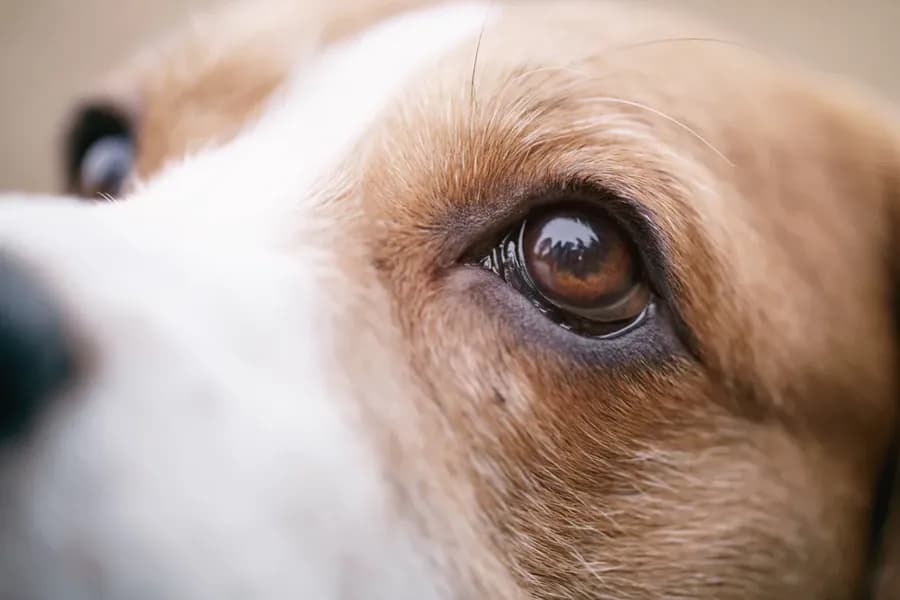
Did you know that when it comes to vision, the eye is just the tip of the iceberg? In fact, our pets' visual system is far more complex than it seems.
What is an eye made of?
The eye, also known as the eyeball, is a relatively complex and delicate structure. The outer shell consists of the sclera—the white part, often called the "white of the eye"—and the cornea—the transparent section. This allows the iris to show through, which can be various colors and features a "hole"—the pupil—whose diameter changes depending on light intensity. Behind the iris lies the crystalline lens, a true intraocular lens enabling accommodation. It is attached to the ciliary bodies by suspensory ligaments. Deeper inside, covering the sclera, is the choroid, rich in blood vessels. This structure, responsible for "nourishing" the back of the eye, is itself covered by the retina, which is packed with photoreceptor cells.
The eye consists of two chambers and two segments:
- The anterior chamber, located between the cornea and the iris;
- The posterior chamber, situated between the iris and the lens;
- The anterior segment, comprising the two aforementioned chambers, which contains the aqueous humor responsible for nourishing these two structures—this fluid is produced by the ciliary bodies;
- The vitreous chamber, located behind the lens, which contains the vitreous body.
These two fluids—the aqueous humor and the vitreous body—also maintain intraocular pressure.
The eyeball is also surrounded by accessory structures that provide protection. This is particularly true for the eyelids, of which dogs and cats have 3:
- The upper and lower eyelids, topped with lashes;
- The third eyelid, or nictitating membrane.
The lacrimal glands produce tears, which provide both mechanical protection (by preventing dryness and lubricating the cornea) and immunological protection (since tears contain numerous immune cells!). These are then drained through the lacrimal duct.
Visual Pathways
In reality, the eye is only the first step in vision. The analysis and interpretation of what this organ perceives take place in the visual cortex, located in the posterior part of the brain.